Why We Chose Wails & Go Over Electron for ForgeADE's Architecture
An architectural breakdown of building a native AI-first developer environment with Go backend and lightweight WebView frontend.

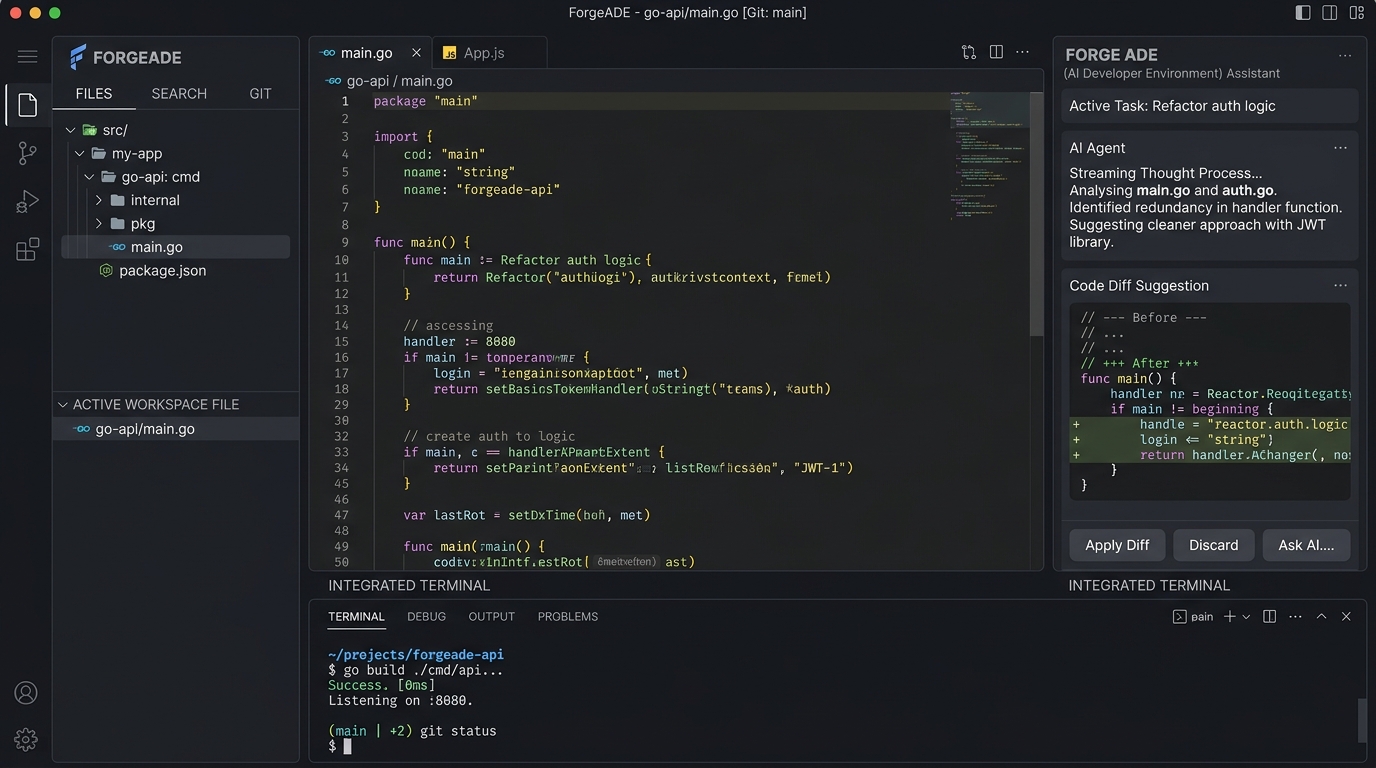
When designing ForgeADE — an AI-first software engineering workspace — one of the most critical decisions was selecting the desktop foundation. Modern software engineers already suffer from heavy development environments where editors, language servers, and containers consume massive system resources.
We wanted ForgeADE to feel like a high-precision instrument: instantaneous startup, sub-80MB baseline memory usage, and native local file IO. That led us to reject Electron and build with Wails (Go + Native OS WebView).
The Overhead of Electron
Electron bundles a full Chromium browser instance and a Node.js runtime inside every application package. For a complex IDE containing an integrated terminal, syntax highlighter (CodeMirror 6), and local AI agent daemon:
- Baseline RAM Consumption: An empty Electron shell routinely consumes 180MB - 350MB of RAM before opening any file.
- IPC Serialization Overhead: Large file buffers passed between Node.js and Chromium renderer threads suffer JSON serialization penalties.
The Wails Advantage
Wails couples a compiled Go binary backend with the operating system’s native WebView (WebKit on macOS, Webview2 on Windows):
- Native Concurrency: Go goroutines handle heavy background tasks — git status polling, terminal pseudo-terminal (PTY) emulation, and file system indexing — without blocking the UI thread.
- Tiny Binary & Instant Launch: Without bundling Chromium, the resulting application bundle is dramatically smaller and launches in less than 400ms.
- Local AI Agent Integration: Local LLM connections and streaming sockets are managed directly in compiled Go code, minimizing latency.
Architectural Trade-offs
While building with native WebViews requires handling cross-platform rendering nuances, the performance dividends and resource savings make it the clear architectural winner for developer tools in 2026.